
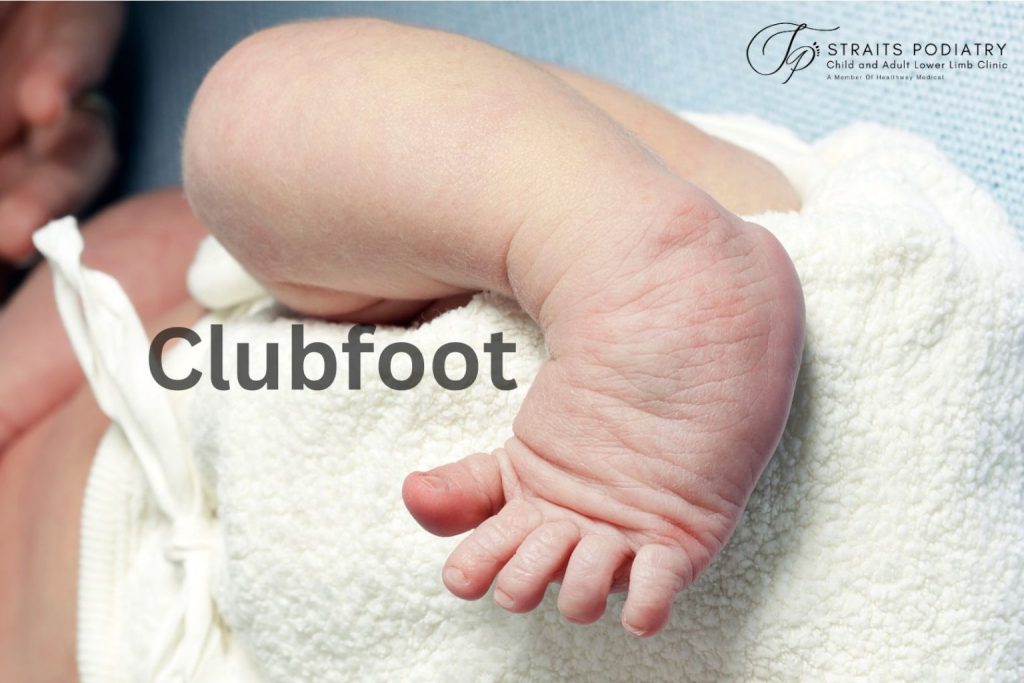



Clubfoot is a congenital paediatric foot condition that affects the development of a baby’s feet. It causes one or both feet to turn inward and downward. While the exact cause of clubfoot is unknown, it is believed to be a combination of genetic and environmental factors. The condition can be diagnosed through a physical examination by a podiatrist or orthopaedic surgeon.
At Straits Podiatry, we understand the impact that clubfoot can have on a child’s life, and we want to provide parents with the information they need to make informed decisions about their child’s health. In this article, we will provide a comprehensive guide to clubfoot, its causes, diagnosis, and treatment options.
Clubfoot, or talipes equinovarus, is a congenital disorder that affects one or both of a newborn’s feet. It is a relatively uncommon foot deformity that occurs in about 1 in 1,000 births. Clubfoot causes the baby’s foot or feet to turn inward and downward, making walking and wearing shoes difficult. It is a non-life-threatening condition but can be severely debilitating without early treatment. This condition should not be confused with in-toe walking or metatarsus adductus, where only the feet turn inwards when a child walks.
There are two main types of clubfoot: idiopathic and non-idiopathic. Idiopathic clubfoot is the most common type, and its cause is unknown. Non-idiopathic clubfoot may result from other factors, such as neurogenic, myogenic, or arthrogrypotic conditions. Regardless of its type, early diagnosis and treatment are essential for the best possible outcome.
The exact cause is unknown, but it is believed to be a combination of genetic and environmental factors. Studies have shown that if one or both parents have clubfoot, their child’s chances of being born with the condition increase significantly. Other risk factors include:
Clubfoot is generally noticeable at birth due to its distinct appearance. The doctor will typically refer your child to an orthopaedic doctor to determine the severity of the condition. They may also order X-rays or an ultrasound to evaluate the bones and joints in the feet.
The treatment of clubfoot depends on the severity of the condition. In mild cases, the podiatrist may recommend stretching exercises, foot and ankle braces, and a series of casts to gradually move the foot into the correct position. In more severe cases, surgery is almost always necessary to correct the deformity. After treatment, the child will need to wear special shoes or braces to maintain the correct position of the foot for several years.
Clubfoot can be severely debilitating if left without early treatment. Although doctors normally notice the condition at birth, some mild cases will be too difficult to detect. You should bring your child to a medical professional if you suspect he or she has the condition. Remember, early diagnosis and treatment are crucial to ensuring the best possible outcome for your child’s foot health.
Chief Podiatrist, B.Pod(Hons). Your foot and lower limb specialist passionate about raising awareness for foot and lower limb health.