Clawed and Hammer Toes

What are Clawed and Hammer Toes?

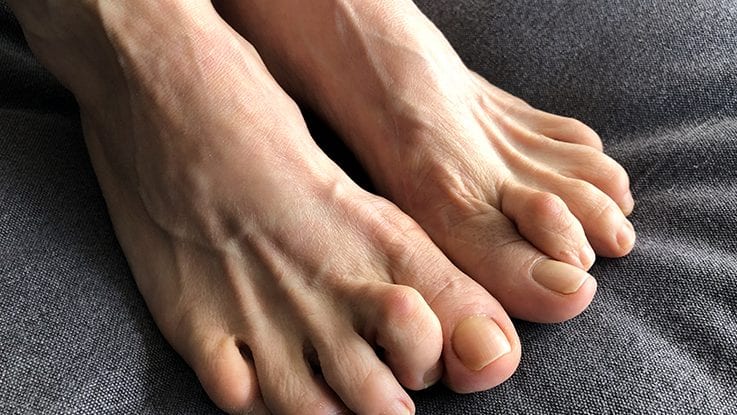
Clawed toes and hammer toes are toe deformities that can cause foot pain or other foot conditions. They often occur when there is a muscular imbalance in the foot, causing the toe to remain in a bent position. Clawed and hammer toes can be flexible (able to straighten) or fixed deformity (unable to straighten).

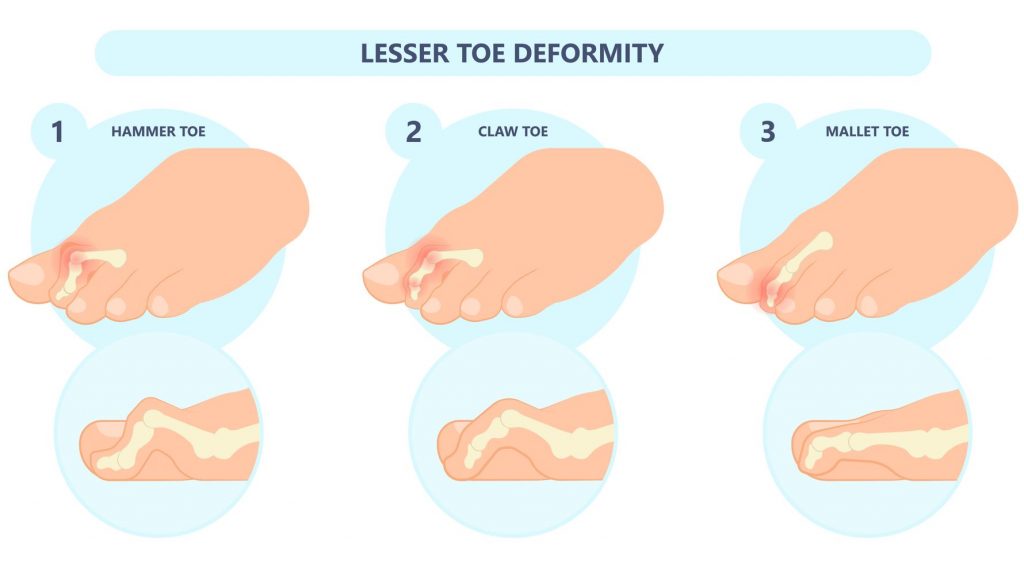
Clawed toes appear as toes that curl downwards like a “claw”, characterized by hyperextension of the metatarsophalangeal joint (MTPJ) and flexion of the proximal interphalangeal joint (PIPJ) and distal interphalangeal joint (DIPJ).

Hammer toes differ from clawed toes slightly where only the middle part of the toe is curled, and are characterized by hyperextension of the MTPJ, flexion of the PIPJ and extension of the DIPJ. There is a third type of toe deformity known as mallet toe, where only the tip of the toe is curled downwards.

Causes of Clawed and Hammer Toes

The primary cause of clawed and hammer toes is muscular imbalance. There are tendons attached to the top (extensor tendons) and bottom (flexor tendons) of our toe bones and are responsible for bending our toes upwards (extension) and downwards (flexion). Both extensor and flexor tendons work in balance to stabilise our toe in a straightened position.

Various risk factors such as tendon tightness, and abnormal foot posture can disrupt the stability between extensors and flexors, causing one to overpower the other, resulting in clawed or hammer toes.

Need Help? See Our Podiatrist Today

Risk Factors of Clawed and Hammer Toes

Risk factors of clawed and hammer toes include:

  • Flat feet (pes planus) – resulting in flexor stabilisation
  • High arch feet (pes cavus) – resulting in extensor substitution
  • Muscle wasting (e.g muscular dystrophy, diabetic neuropathy)
  • Poor-fitting footwear (e.g too long or too short)
  • Previous trauma or fractures

Conditions Associated with Clawed and Hammer Toes

Conditions that can be caused by clawed and hammer toes include:

Clawed and Hammer Toes Management

Management for clawed and hammer toes largely depends on whether the deformity is fixed or flexible. For fixed deformities, the aim of management is to reduce pressure at the tip of the toes and ball of the foot. For flexible deformities, management is aimed at straightening the toes when one is weight-bearing.

Management options for clawed and hammer toes include:

  • Changing to well-fitting footwear
  • Customised padding or toe props to reduce pressure at the tip of toes or ball of the foot
  • Customised foot orthoses to improve foot posture
  • Stretching and strengthening of foot muscles

Share With Us 

Search

You May Also Like

Do You Have A Question? Ask Us...

Search

Do You Have A Question? Ask Us...

You May Also like

Categories

Categories

About Us

Conditions

Treatments

Feet

Ankle

Leg

Knee

Paediatric Conditions

Rheumatology

Skin & Nails

Diabetic Foot

Heel Pain

Foot Pain

Plantar Fasciitis

Achilles Tendonitis

Flat Feet

High Arch Foot Type

Arch Pain

Bunions

Hallux Rigidus

Sesamoiditis

Plantar Plate Injury

Metatarsalgia

Foot Drop

Tarsal Tunnel Syndrome

Baxter’s Nerve Entrapment

Clawed and Hammer Toes

Heel Spurs

Morton’s Neuroma

Accessory Navicular

Ankle Injuries

Posterior Tibial Tendon Dysfunction

Chronic Ankle Sprain

Acute Ankle Sprain

Talar Dome Injuries

Ankle Impingement

Knee Pain

Runner’s Knee

Jumper’s Knee

Meniscus Tear

Iliotibial Band Syndrome

Knee Osteoarthritis

Children’s Flat Feet

In-toe Walking

Toe Walking

Knock Knees

Paediatric Heel Pain

Juvenile Bunions

Osteochondrosis

Kohler’s Disease

Iselin’s Disease

Osgood-Schlatter Disease

Rheumatoid Arthritis

Gout

Fungal Nails

Plantar Warts

Ingrown Toenails

Fungal Skin

Corns and Calluses

Diabetic Peripheral Neuropathy

Diabetic Foot Ulcers

Peripheral Arterial Disease

Charcot Foot