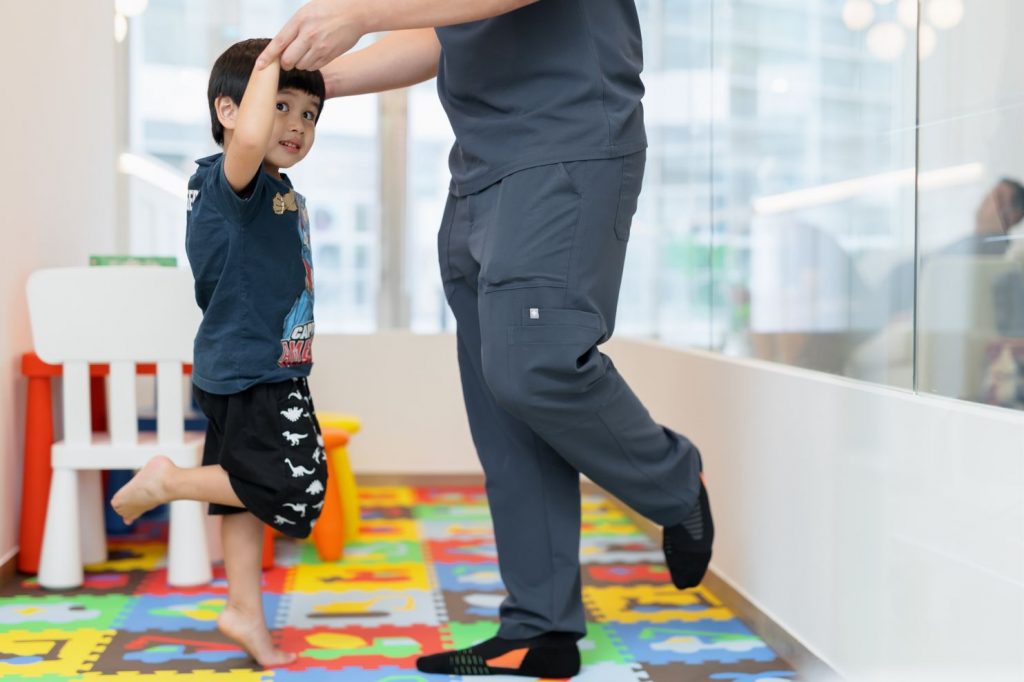
Toe walking, commonly referred to as “walking on tippy toes” by parents, is a condition to describe children who walk without heels touching the ground. Toe walking is a form of gait disorder associated with several underlying neurological or muscular conditions, such as cerebral palsy, muscular dystrophy, and autism. If left untreated, toe walking can lead to other injuries and conditions to the lower limb.
How Common is Toe Walking?
Toe walking is estimated to affect 5 in every 100 children with no underlying conditions, 2 in every 10 children with autism spectrum disorder, and up to 4 in 10 children with underlying neuromuscular conditions. Toe walking, if within the normal development phase, can be considered normal and may resolve with proper medical guidance and supervision. Most children will develop a normal heel-to-toe gait pattern around the age of 2 onwards.
Toe walking is classified into 3 different types, namely developmental toe walking, idiopathic toe walking or associated with underlying conditions. A trained Podiatrist will be able to differentiate the types of toe walking conditions, and this is the key to providing the correct form of management.
Developmental Toe Walking (DTW)
Children with DTW have no underlying conditions and toe walking is just an unusual presentation of their normal development
Such cases should resolve by around the age of 3 onwards
Idiopathic Toe Walking (ITW)
Children with ITW have no apparent underlying cause
Are not associated with any neurological or muscular disorders
Commonly have a strong family history of toe walking
Toe Walking associated with Underlying Conditions
Common conditions associated with toe walking include autism, cerebral palsy, muscular dystrophy, or clubfoot
Signs of toe walking could be an early indicator of the above conditions
Early detection through thorough assessment is crucial
Congenital foot ankle and deformity (e.g clubfoot)
Muscular spasticity
Achilles tendon contracture
Sensory integration disorder (e.g sensitive to certain textiles
Developmental delay
Hypermobility of the foot and ankle joints
Signs and Symptoms of Toe Walking
Toe walking is a visible gait disorder and children with the condition will walk on their tippy toes.
Other signs and symptoms include:
“Bouncing” gait pattern
Walk on tippy toes when the child is excited
Walk on tippy toes on certain floor surfaces (e.g carpet, beach)
Toe Walking Treatment in Singapore
Differentiating the type of toe walking is the key to providing the right management plan. Treatment for toe walking usually involves a process of restricting movement and retraining movement. Sometimes, your medical professional may refer the child for further investigation to rule out any underlying neurological or neuromuscular conditions.
Treatment options for toe walking in Singapore includes: